
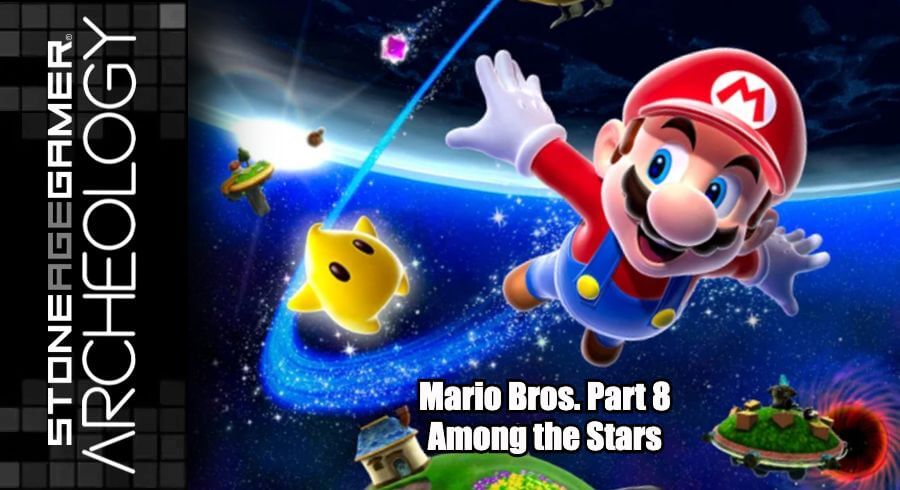
Mario Bros. Retrospective Part 8: Among the Stars
Welcome to Part 8 of our Mario Bros. retrospective!In this episode, Mario launches one of his most successful, and divisive, sub series, and heads into space for some out of this world adventures. Meanwhile, Princess Peach finally gets her time to shine, and Nintendo revolutionizes the entire industry with Wii.
Video Works: https://youtu.be/cdUDvoGFp8s?si=8tZLecvzwVAtWLIJ
The Super Mario Wiki: https://www.mariowiki.com/
The Gaming Historian: https://thegaminghistorian.com/
Leonard Herman: http://www.rolentapress.com/
Supper Mario Broth: https://www.suppermariobroth.com/
DJMykah: https://www.youtube.com/DJMykah
OC Remix: https://ocremix.org/
Transcript of the video
The battle between the PlayStation 2, Xbox, and GameCube had proven to be remarkably fierce, and Nintendo’s attempt to compete with Microsoft and Sony on their terms failed to yield their desired results. Fortunately, their future laid outside of the traditional console arms race. So while they made one final push to put the GameCube on equal footing with its competition, they also began hedging their bets with a new piece of hardware that would kick off a bold new direction for the company. One that would eventually land them in a category all their own.
Nintendo’s presentation at the 2004 Electronic Entertainment Expo began with the introduction of future CEO and President of Nintendo of America, Reggie Fils-Amie. Immediately following his memorable on-stage debut was an onslaught of trailers that aimed to back up their slogan for the year “we make games that make games worth playing.” Stunning new trailers from Nintendo and 3rd parties alike, including one of the most memorable moments in the event’s history, the reveal of the next Legend of Zelda for Nintendo GameCube, showed a vision of the company that was ready and able to compete with their rivals. But beyond their impressive slate of software came the introduction of a third pillar in their existing hardware ecosystem, the Nintendo DS.
Similar to the Game Boy Advance, the Nintendo DS was a new handheld platform that at first glance appeared to be a next generation evolution of the GBA. It was backward compatible with Game Boy Advance software, housed enough power to render polygonal graphics for 3D games on the go, had 4 face buttons, wi-fi capabilities, and folded in half like the immensely popular Game Boy Advance SP. But there was one major difference at the center of its design intended to quite literally change the way people played.
Drawing inspiration from the Multi-Screen Game & Watch units from the early 1980s, the DS featured a unique dual screen design, the definition of its namesake. The top screen was a standard display, but the bottom one was a resistive touchscreen which could be controlled via an included stylus. This unique play interface raised numerous questions from fans, but provided a fascinating new tool for developers to create with. It was also the start of what would be called Nintendo’s Blue Ocean marketing strategy, where they wouldn’t just aim their new products at the existing games market, but attempt to expand beyond to a more casual audience, creating experiences that anyone could play, regardless of their gaming expertise.
Of course, this didn’t mean their new games were going to be aimed at this potential new market alone, but rather it was intended to compliment their more traditional fare, and unlike the Game Boy Advance and GameCube before it, this time around Mario would be on hand to show the world what this new system could do.
Nintendo brought not one, but two new Mario adventures to the show floor to illustrate the power of their new DS hardware. One was a game called New Super Mario Bros. While clearly very early on in development, and only shown off in video form, this appeared to be a brand new 2D Mario adventure, featuring a polygonal version of the character adventuring through traditional, sprite-based worlds. There wasn’t much in terms of actual level design on display, with largely flat surfaces for Mario to run around on, and it didn’t do much in terms of showcasing the dual screen nature of the handheld, but it did place a focus on special mushrooms that could turn Goombas enormous, as well as Mario himself, who could then rampage through bricks and enemies, including Bowser, with ease.
The other was something far more in line with what fans had come to expect from Nintendo’s handheld Mario games, an enhanced port of another of the character’s home console classics, Super Mario 64.
Referred to at the show as Super Mario 64x4, Nintendo placed their focus on the game’s new local multiplayer mode, as four characters freely ran around the grounds in front of Peach’s castle, competing to grab stars within a time limit. There was also a single-player demo where show-goers could run through Bob-omb Battlefield, the game’s first stage, as well. The DS’s top screen displayed the action, while the bottom showed a map which kept track of where all of the characters were at any given time. The visuals appeared to be noticeably improved over the Nintendo 64 original, with far more detailed environments and character models on display.
New Super Mario Bros. wouldn’t be heard from again for some time, but a few months after E3, the Nintendo DS launched in North America, and right alongside it was Mario, returning to his first 3D adventure in portable form.
Super Mario 64 DS was released as a launch title for the Nintendo DS on November 21, 2004. As expected, it was a full remake of the Nintendo 64 classic Super Mario 64, with a number of interesting additions to keep things fresh, including who players took control of at the start of the adventure.
The game began in nearly identical fashion to the N64 original, with Princess Peach inviting Mario to her castle for some cake. But after Mario jumped out of his pipe, Luigi and Wario showed up as well. The three of them ran toward Peach’s castle, while Yoshi took a nap nearby. After the trio seemed to go missing within the castle, Lakitu woke Yoshi up, and the green dinosaur went in after them.
From here, the game more or less played out the same as the original, except with players taking control of Yoshi instead of Mario, accompanied by a comprehensive visual facelift. Nearly every aspect of the game’s graphics had been redone with more complex geometry, updated textures, and new animations. As the player progressed though the game, they were eventually able to free Mario, Luigi, and Wario, unlocking them as playable characters too. Mario played the same as he did in Super Mario 64, while Yoshi incorporated his flutter jump and tongue, Luigi had his trademark long jumps with low traction, and Wario utilized more melee attacks. But on the whole, Super Mario 64 DS was largely the same adventure players knew and loved from the Nintendo 64, with one notable exception, the way they interacted with it.
Super Mario 64 was created in conjunction with the Nintendo 64’s controller, with its primary feature being the analog stick. The Nintendo DS, though, only featured a D-pad and touchscreen, which meant that fundamental changes were necessary in the way players controlled the experience. Characters could only move in 8 directions now instead of a full 360, and there was now a dedicated run button, since running speed could no longer be determined by the analog stick’s orientation.
There was an option to utilize the touchscreen as a sort of virtual analog stick, but without the feedback of a physical controller, many players found this scheme to be far less functional.
Super Mario 64 DS also played host to numerous multiplayer modes, a feature missing from the Nintendo 64 original. Players could compete in a number of open arena-style stages where they had to collect the most stars within a time limit to win. While playing, stars would appear in various locations which displayed on the bottom map screen. Once a player grabbed a star, a new one appeared somewhere else, and everyone had to decide whether to chase after the new star, or try to beat the existing stars out of their opponents.
In addition to the Vs. Mode, there was also a series of minigames ranging from a simple spot the difference game to more traditional playing card fare, which rounded out the package.
Super Mario 64 DS was a strange release. It provided fans of the Nintendo 64 original with plenty of new things to see and fun multiplayer challenges, and was ultimately a more well-rounded product than the now classic N64 launch title, but the DS’s lack of an analog stick left many feeling that the act of actually playing the game was far less enjoyable, despite the visual upgrades and additional content. Still, it was a successful launch, and helped kickstart the DS on its road to becoming one of the best-selling console releases of all time.
As for the other Mario game that was shown off at E3, it would be another two years before it landed on store shelves. In the meantime, another one of Mario’s friends would finally get their shot in the spotlight.
In the January 2005 issue of Nintendo Power, their Game Watch section featured a segment about upcoming Nintendo DS games being developed in Japan, and the top story was a brand new game starring Princess Peach. The two screenshots on display featured colorful visuals on the bottom screen, and a closeup of Peach herself on the top. Very little information was given besides the game being a platformer and that Peach would be wielding a parasol, but what little was there showed enormous promise, especially for fans of the character who had been waiting for years to see her finally take on a starring role. They would be made to wait just a bit longer, but one year later, at long last, the princess of the Mushroom Kingdom got her very own game.
Super Princess Peach was released for the Nintendo DS in February 2006, providing Mario’s frequent damsel in distress with her first proper starring role. The game was a 2D platformer where Peach could run, jump, slide, attack, and more in a brightly colored world reminiscent of the visuals established in Super Mario World 2: Yoshi’s Island. But unlike Mario’s powerup system, Peach’s abilities in this game were centered around emotions.
Upon hearing of a magical land called Vibe Island, Bowser and his minions set out to get their hands on the Vibe Scepter, a valuable treasure that resided there. Once obtained, Bowser was able to gain control over peoples emotions, but thanks to its reckless use by one of his minions instead caused everyone’s feelings to spiral out of control. This, however, didn’t stop Bowser from enacting his new nefarious plan, which was notably different than usual. Instead of capturing the princess, he sent his troops after the Mario Brothers directly, leaving Princess Peach to rescue the plumbers. Teaming up with a magical parasol named Perry, Peach headed to Vibe Island to recover her friends, but thanks to the effects of the Vibe Scepter, anyone who stepped foot on the island was susceptible to violent mood swings. This actually worked in Peach’s favor though, as unlike everyone else, she was able to harness the power of her mood to grant her abilities that would help her on her quest.
Joy would allow Peach to float through the air to reach new areas, Rage caused her to catch fire, lighting various lamps, candles, and more. Gloom caused a stream of tears which could be used to power water wheels and extinguish flames, and Calm could be used to restore her health.
Peach and Perry travelled across eight worlds, eventually arriving at Bowser’s Villa, where after defeating his minions, she faced off against her often kidnapper in a far more physical battle than even Mario was typically faced with. In the end, Bowser was defeated, the plumbers were freed, Vibe Island was returned to normal, and everyone went home in peace.
Super Princess Peach may not have been an actual Mario platformer, but it was one of the most impressive-looking side-scrolling adventures the series had seen to date. Peach, Perry, and all the various enemies new and old featured beautifully animated sprites. Still, the game left fans divided. On one hand, some thought it was long past time for Peach to get her own game, with her only previous starring role technically being Princess Toadstool's Castle Run, a promotional LCD watch game from 1990, but the focus on emotions also left some feeling that the character deserved a better representation for her first starring role. Unfortunately, Super Princess Peach would be Peach’s only solo outing for 18 years, followed up by Princess Peach: Showtime for Nintendo Switch in 2024. Still, the game reviewed relatively well, sold over a million copies, and is often looked back on as a hidden gem in the DS’s library.
But for as fun as Super Princess Peach was, a seismic success story was about to hit the platform just a few months later, as Mario’s other showing from E3 2004 was finally ready to go.
New Super Mario Bros. released for the Nintendo DS in May 2006, bringing the first fully original 2D Mario platformer to players in over 13 years.
The story was extremely simple, consisting of Mario being distracted by some storm clouds so Bowser Jr could capture the princess. The Mario brothers then set out across a fresh set of eight worlds to get her back, and defeat Bowser Jr and his father one more time in the process.
New Super Mario Bros. set out to be exactly what the title suggested, a new Super Mario Bros. game. But its approach was less one of evolution, and more of refinement. The freedom and exploration present in Super Mario World was scaled back significantly in favor of more straightforward level designs, more similar in complexity to those found in Super Mario Bros. 3. There were no powerups that granted Mario the gift of flight, nor were there any Yoshis to ride. Instead, it struck a middle ground in terms of modernization, with plenty of secret stages and exits to uncover, but with a far more simplified map screen than its predecessors.
The game’s visuals were a first for the series, with Mario himself, as well as a number of the game’s enemies, appearing as polygonal figures, while the environments, coins, items, and other elements were made of traditional sprites. This gave the game a fairly unique look among its counterparts, with the power of the Nintendo DS allowing for some more ambitious stage and camera movements, and the Mario brothers’ maneuvers to animate more fluidly in 2D than ever before.
But as always, it wouldn’t be a new Mario game without some new powerups, and New Super Mario Bros. kept that tradition alive with a trio of interesting new abilities. The Blue Shell transformed Mario into a Koopa Troopa. Similar to the Hammer Suit from Super Mario Bros.3, Mario could duck to use his shell for defense, but he could also curl up inside while running to dart around stages like a kicked Koopa shell, causing all manner of damage in his wake. The Mega Mushroom would transform Mario into Mega Mario, an enormous version of himself that was nearly indestructible, and able to trounce his way through bricks, enemies, pipes, and even the stage architecture itself with ease for a limited time. But perhaps the most interesting of all was the Mini Mushroom. This shrunk Mario down to a tiny size, which would affect his jumping abilities, allowing him to use his light weight to clear extraordinary distances, and run across the surface of water. This light weight, however, came with a few drawbacks, including dying from a single hit, and not being able to harm enemies by landing on them without the assistance of a ground pound. But Mario’s small size also allowed him to access areas that he couldn’t otherwise, like small hidden passageways and miniature pipes. These led to secrets that often contained large gold coins, three of which were placed in each of the game’s stages, which were themselves used to access secret areas on the map. Successfully completing certain Boss battles as Mini Mario was also the key to unlocking entire new worlds to explore.
As for the system’s dual screens, New Super Mario Bros. didn’t make much use of them. Information displayed on the bottom touch screen was largely ineffective, with a secondary item able to be stored there, accessible with a tap on the touchscreen, and a sort of progress bar showing how far into a level you were. But aside from a charming effect where traveling underground made the playfield appear on the bottom screen instead of the top, the touchscreen failed to add anything of value.
What was of value though, was the game’s multiplayer mode. Returning from Super Mario 64 DS were numerous multiplayer minigames to enjoy, but the real draw was the new versus mode. Unlike the brilliant races of Super Mario Bros. Deluxe, New Super Mario Bros vs. Mode featured infinitely looping stages. Instead of being a race to the finish, this game was all about who could grab the most stars, not entirely dissimilar to the versus mode in Super Mario 64 DS. Players would run through the environments collecting powerups and searching for stars that would appear in various locations. The first one to grab five stars would win, but the process of holding onto the stars once you got them was more difficult than it looked. Opponents could knock stars out of the competition’s inventory by jumping on their heads, hitting them with fireballs, or generally knocking them around, while if a player happened to get hit by an enemy or fall into a pit, their stars would be free game, bouncing around the stage wherever the incident occurred. The matches could get surprisingly intense, helping extend the life of the game beyond the single player campaign exponentially, and earning it a reputation as one of the most enjoyable local multiplayer games on the system.
New Super Mario Bros. seemed like an unassuming project, and came at a time when 2D games in general were often considered lesser experiences, but its popularity told a very different story. While Super Mario 64 DS went on to sell a rather impressive 11 million units, New Super Mario Bros. was a sales powerhouse by comparison, moving over 30 million copies during its lifetime. Its simplicity was noted by longtime fans as something of a disappointment, but its back to basics approach resonated with audiences, and Nintendo took notice. New Super Mario Bros. was the future of 2D Mario platformers. But the character’s 3D games were about to get much more ambitious.
Over a short period of time, the Nintendo DS had shed its third pillar status into becoming the legitimate successor to the Game Boy Advance. Its unconventional display and touch screen fully caught on with players and developers alike, and as hoped, helped Nintendo reach an expanded audience like never before. Casual gamers were flocking to the DS, and Nintendo wanted to bring that excitement to their home console line with the GameCube’s successor, the Nintendo Revolution. Its initial reveal at E3 2005 was cryptic, especially in terms of what would eventually make the system every bit the revolution its name promised. A few months later at the 2005 Tokyo Game Show, Nintendo unveiled their new console’s secret weapon, its groundbreaking new controller concept, and players finally began to wrap their heads around what Nintendo had now officially dubbed Wii.
Its unique input device would bring motion controlled gaming to the masses, and they managed to illustrate this without actually showing off any games, instead presenting a video segment of people playing with the new Wii Remote, accompanied by various recognizable sounds. Swinging a baseball bat, chopping food, conducting music, and of course, the iconic sound of Mario jumping with the flick of a wrist. This ignited speculation on what a new motion controlled Mario game could actually be like, and also gave fans hope that unlike the GameCube, the Wii might just launch with a new Mario game. Media and fans alike had no shortage of questions surrounding this mysterious new Wii and its theoretical new Mario game, and shortly thereafter, Nintendo gave some much-needed answers at E3 2006.
Their presentation began with Shigeru Miyamoto conducting music with a Wii Remote, which transitioned to a sizzle reel showing off some of the games they had in development for Wii. Among them was the debut of a brand new 3D Mario adventure.
The game was called Super Mario Galaxy, and it showcased Mario in some truly inventive gravity-defying positions. A longer version of the trailer shown at the press conference was made available online, as were hands-on impressions from show goers, and the initial buzz was extremely positive. Fans at home, though, would have to wait more than a year to experience the latest Mario adventure, as Mario and his friends were once again absent from the Wii’s launch in November 2006. During that time, the Wii became a remarkable sales success, thanks to the popularity of its pack-in game Wii Sports drawing in that all-important casual market that the Nintendo DS had struck a chord with previously, coupled with the latest Legend of Zelda game, Twilight Princess, for Nintendo’s core audience. Wii was taking the entire world by storm, becoming yet another cultural phenomenon for Nintendo, so much so that their competitors quickly worked to introduce motion controls into their own ecosystems, but it was Nintendo that absolutely dominated the hardware market of the time. And as Wii sales continued to soar, so did the anticipation for Mario’s space-faring adventure. And that wait, would prove to pay off.
Super Mario Galaxy released on November 12th, 2007 for Wii, finally bringing 3D Mario to Nintendo’s successful new platform in remarkable style.
The game opened with a story about a comet that flies over the Mushroom Kingdom every hundred years. This was celebrated with a Star Festival, where Toads would collect the shooting stars the comet left in its wake, and bring them to the castle where they would become a Great Power Star. One year, Princess Peach invited Mario to the festival mentioning that she had a present to give him. But before he could make it to the castle, Bowser and his fleet of airships attacked, trapping the Mushroom citizens in crystals, and causing his usual degrees of chaos. Bowser informed Peach that she was invited to witness the creation of his new galaxy, summoned a spaceship, which lifted Peach's castle out of the ground, and disappeared into space. Bowser’s plan was to use the power of the stars to create his own galactic empire, and Mario, in his attempt to stop him, found himself knocked away, landing on a tiny planet. There, he came face to face with a small bunny, who introduced the players to the game’s unique mechanics, which were all about gravity. While the basics of the gameplay were essentially the same as any other 3D Mario game, the stages themselves took place on a series of small structures and planets, each with their own unique gravitational fields. Jumping off the side would pull Mario around as if he were an orbiting entity, while falling into the center of a gravity well would spell certain doom. The same went for walking. If Mario approached the edge of a structure, instead of falling off the side, he would simply wrap around and continue walking in tandem with the game’s gravity.
After catching the rabbit, more appeared, and they turned into strange, chubby star creatures who wondered if Mario could possibly help someone they called Mama. This, it turned out, was a celestial woman in a blue dress named Rosalina.
She explained to Mario that she was a sort of galactic guardian who has been watching over the events of the Star festival. In order to aid Mario in his quest to rescue Peach, she granted him the ability to travel through space via one of her assistants, the small star people who posed as the rabbits, which were called Lumas. Rosalina then tasked Mario with tracking down a series of missing Grand Stars, like the one Peach had at the Star Festival.
With Mario’s new Luma powered ability, players should shake the Wii remote to make Mario perform a spin attack that could break various obstacles, as well as activate launch points, which would rocket Mario through space toward new locations, planets and stars, forming the new core of the level structure. Mario would land on a planet, perform a task that created a launch star, which would take him to another location, and so forth until he collected that stage’s star, and moved onto the next.
The game’s visuals were stunning, easily among the best seen on the platform, running at a near constant 60 frames per second, with some gorgeous art direction to accompany it. And of course, once again there were new powerups, of which Super Mario Galaxy had more than any previous 3D entry.
In addition to this being the first appearance of Fire Flower in 3D, there was also a Bee Mushroom that granted Mario limited flight and the ability to stick to certain surfaces, the Boo Mushroom that transformed Mario into Boo Mario, who could phase through walls, the Ice Flower that let Mario create ice surfaces on water and lava to skate over, the Spring Mushroom which turned Mario into an unwieldy spring, and the Red Star, which granted Mario the ability to fly freely for a limited time.
What else Super Mario Galaxy had in quantity was lore, as long as you were willing to look for it. Serving as the game’s central hub area was the Comet Observatory, where Rosalina and the Lumas resided. There, players could access a library where the story of Rosalina’s past could be told over the course of ten chapters. It was a surprisingly somber and touching tale, far more so than previous Mario adventures, and helped endear the new characters to those who took the time to listen.
But Rosalina and the Lumas weren’t the only new characters in Super Mario Galaxy. There was also the toad Brigade, lead by Captain Toad, who made his first appearance here, as well as the cavalcade of enemies that Bowser brought with him for Mario to face, including some huge, unforgettable bosses.
Once Mario had collected enough Grand Stars, it was finally time to face Bowser in a tremendous cosmic showdown. The battle spanned several small planets and required Mario to make use of nearly every trick he had learned throughout his adventure. With the mad sorcerer defeated, and the last Grand Star returned to Rosalina, Mario was finally able to rescue Peach and return her and her castle to the Mushroom Kingdom where they belong.
But while the story ended there, the game did not.
Once players had acquired 120 power stars, they could play through the entire adventure as Luigi, who once again could jump higher but had less traction, and collect a whole new set of stars. Only by completing the adventure with both Mario brothers could players see the true depths of the game’s challenge in the Grand Finale Galaxy, which contained the 121st star.
Super Mario Galaxy was lauded as a triumph by both fans and critics alike. Its impressive visuals may have been hindered by the nature of the Wii’s standard definition output, especially when compared to the competition’s adoption of high definition video, but it still managed to catch on big with audiences thanks to its accessible gameplay, and overwhelming levels of creativity. New Super Mario Bros. may have been lighting up the charts on the DS, but Super Mario Galaxy had the trademark sense of wonder that had accompanied the best Mario games of old, and the new characters, especially Rosalina, quickly became series mainstays.
Following the years of mixed reactions to the GameCube’s Mario Sunshine and the re-releases of the Super Mario Advance series, it seemed that the prestige of a new Mario release was officially back. He had all-new, all original titles on both of Nintendo’s current generation platforms, and they were both selling incredibly well. Though one was clearly moving faster than the other, New Super Mario Bros.
Nintendo’s Blue Ocean strategy was working wonders on the DS, with titles like Brain Age selling to the casual audience in record numbers, but New Super Mario Bros. was managing something even more impressive. It successfully appealed to both the casual and core markets. So with Wii Sports replicating and even surpassing Brain Age’s success at home, it seemed only natural to try to complete that parity with another New Super Mario Bros. Though industry trends dictated that a high profile 2D game couldn’t be successful on a home console, Nintendo had changed the game with Wii, and decided to take the risk anyway. Two years later, for the first time since the launch of the Super NES, Nintendo would bring a brand new 2D Mario adventure to living rooms everywhere.
New Super Mario Bros. Wii was released for the Wii in November 2009 in a special red case, which stood out among the standard white cases Wii games normally came packed in.
The game opened at Princess Peach’s birthday party. An enormous cake made its way into the room, and out of it popped Bowser Jr and the Koopalings, making their mainline series return here for the first time since Super Mario World. They immediately kidnapped the princess, and scattered across a series of familiar-looking worlds in their very own airships. As always, Mario and his friends had to travel the land, defeat the Koopalings and Bowser Jr., and of course, yet again, Bowser himself. The game was remarkably similar in style to New Super Mario Bros. on DS, but there was still plenty of new to be found under the surface.
Thanks to the more powerful hardware, the game’s stages could be even more active than before. There were now rotating platforms and a more dynamic camera that paved the way for the game’s central new feature, local campaign multiplayer.
Drawing inspiration from the original Mario Bros. New Super Mario Bros. Wii could be played as a competitive/cooperative hybrid for the entirety of its story mode. Up to four players could join in on the fun, which was equal parts hilarious and frustrating. No two players could occupy the same space, which meant that any precision platforming had to be done by taking turns, and also that it was all but guaranteed that players would be knocking one another around while trying to survive. This was made all the worse, or better depending on your perspective, with the ability to pick up and throw other characters, with or without their consent.
The game was balanced by expanding the overall size of the stages to accommodate the player count, and by having item blocks spawn the same number of powerups as there were players on hand. Naturally, there was no way to stop one player from running and grabbing all the powerups for themselves, but that all added to the chaos that ultimately became the game’s defining trait.
In order to keep players from falling behind, New Super Mario Bros. Wii introduced a new bubble mechanic, where if players died or couldn’t otherwise keep up with the action, they would appear in an invincible bubble that needed to be popped by another player in order to advance.
As usual, new powerups were once again on-hand. The Ice Flower made its 2D debut here, allowing characters to throw ice balls which would freeze opponents in blocks of ice that could be tossed around or used as platforms. The Penguin Suit not only gave Mario the same powers as the Ice Flower, but also let him slide on his stomach. And the Propeller Mushroom gave characters a propeller suit that allowed them to launch themselves high in the sky when the player shook the Wii Remote. Yoshi also made his grand return, with his bottomless appetite flutter jump from Yoshi’s Island in tow.
In addition to this standard fare, was one new ability that managed to potentially fundamentally change the way 2D Mario games could be played, the twirl. If players shook the Wii Remote, Mario could perform the Spin Jump from Super Mario World, but if they did this while in midair, they could execute a twirl that would give him an extra moment of airtime. This move could be repeated as many times as the player could pull it off, leading to some fascinating new expert-level play options. However, the game’s stages were rarely designed with the requirement of mastering this ability in mind. Its usefulness was also largely limited due to its unreliability since it was mapped to a gesture instead of a button press. Still it was an interesting new ability that expanded Mario’s overall efficiency for those willing to take the time to master it.
Unsurprisingly, the overall response to New Super Mario Bros. Wii was a mixed one. On one hand, it was noticeably the least imaginative followup the Super Mario Bros. series had seen since The Lost Levels, featuring largely the same visual assets, environmental designs, and even music as its predecessor. But on the other hand, it was the first proper new 2D Mario game released for a home console since Super Mario World, with easy to understand mechanics, chaotic multiplayer, and one of the best final Bowser encounters in the entire series history. The game’s criticisms were valid, but yet again its appeal successfully struck a chord with both the broad, casual audience that Nintendo had been courting with their “blue ocean” strategy, and longtime Nintendo fans who had grown up with the franchise. New Super Mario Bros. Wii was another phenomenal sales success for Nintendo, once again moving over 30 million units. Still, there was no denying that some fans rightfully felt that this New Mario game didn’t feel so new. Fortunately for them, they were about to get a very different dose of something familiar.
Back in 2007, when Super Mario Galaxy released, players marveled at the astonishing levels of creativity the game had to offer. But what they didn’t know at the time, was that was only a small part of the story. The development team crammed a lot into Galaxy, but they were ultimately forced to leave an even greater than usual amount of clever ideas on the cutting room floor. Thanks to the Wii’s tremendous levels of success though, it wouldn’t be long before they were able to put those ideas into practice in the form of a direct sequel.
Super Mario Galaxy 2 released for the Wii in May 2010, marking the first time a single Nintendo platform saw three original mainline Mario adventures since the NES. While on the surface, Super Mario Galaxy 2 looked remarkably similar to its predecessor, thanks to the reuse of many of the original game’s assets, the underlying adventure took what made the existing formula work, and greatly expanded on it.
The story was effectively a retelling of the same one from Super Mario Galaxy, seemingly taking place at the same time, as if they were parallel versions of the same story being told from different perspectives. Mario was once again invited to Peach’s castle for the Star Festival, Bowser showed up to kidnap the princess and announce his cosmic plans, Mario met some Lumas, and went on a gravity defying adventure to find the Grand Stars and defeat Bowser. This time, though, Mario didn’t wind up on Rosalina’s Comet Observatory. Instead, meeting a big purple Luma named Lubba, who needed power stars to fuel his planetoid shaped spaceship. Upon agreeing to help him, he reshaped the ship into Mario’s likeness, named it Starship Mario, and the group set off across the stars to save the universe.
Unlike the Comet Observatory, Starship Mario didn’t function as the game’s central hub. Rather, Super Mario Galaxy 2 works on a more traditional map system, similar in style to New Super Mario Bros. Stages play out in a mostly linear fashion, with some alternate paths available depending on the player’s choices, making for a more straightforward experience.
As for the gameplay, the core mechanics remained the same, and while the Ice Flower and Red Star didn’t make return appearances, all of the other powerups from the first game returned, in addition to a number of interesting new ones. The cloud flower made Mario lighter, making his jump physics much floatier, and allowed him to create and walk on clouds. The Rock Mushroom allowed Mario to curl into a rock ball and roll around, breaking barriers and objects in his path. And perhaps most exciting of all was the return of Yoshi, whose tongue could not only be used to eat enemies and powerups, but also as a sort of grappling hook for reaching new areas. Yoshi himself could even acquire some unique powerups, like the Dash Pepper that caused him to constantly run at remarkable speeds, the Blimp Fruit which made Yoshi inflate like a balloon, and the Bulb Berry, that made him emit light to help see hidden platforms and illuminate dark areas.
The stages themselves were even more creative than before, featuring more gigantic boss battles, memorable encounters, and devious traps for Mario to avoid., with The toad Brigade and Luigi were along for the ride as well. This once again all lead up to a final encounter with Bowser, and for those brave enough to track down all 240 Power Stars and Green Stars, the final challenge of the Grandmaster Galaxy would become available to put players to the ultimate test.
Super Mario Galaxy 2’s presentation was in many ways much more simple than its predecessor, but the gameplay more than made up for it. It was a tremendous critical success, earning perfect or near-perfect scores from almost every major gaming outlet. Its sales, however, told a different story. Ultimately moving well over 7 million units, its success paled in comparison to Super Mario Galaxy’s 12.8 million, which itself was paltry next to New Super Mario Bros. Wii’s 30. It may have been the most highly reviewed game of the bunch, but its numbers were emblematic of an overall problem Nintendo was having with the Wii. The system had sold astronomically well thanks to the combination of Wii Sports and its revolutionary motion controls, and a small handful of games managed to take advantage of the platform’s enormous install base, but just underneath that veneer of success was a serious issue. The platform’s ecosystem was profoundly unhealthy. Games from both Nintendo and third parties alike, no matter how well well-made, consistently failed to find an audience. The casual games that Nintendo’s Blue Ocean strategy facilitated seemed to be capable of moving decent numbers, but traditional gamers quickly began ignoring the platform in favor of the competition. Adoption rates of HDTVs and online gaming came far more quickly than Nintendo had anticipated, making its standard definition output and anemic internet capabilities a liability. The hardware may have been a phenomenon, but the software, and Nintendo’s core audience, suffered as a result.
It was time for a change, and Nintendo had an idea for a followup to the Wii that they felt could revolutionize the way people played once again, drawing on the access of both the DS and Wii platforms. Unfortunately for them, the rest of the tech world would beat them to the punch.
Join us next time as Nintendo struggles to find its footing in a post Wii world, and creates a whole new kind of Mario game in the process.